The dataset
Across nine recent cases on different wells of an international oil company, Spotter was tracked when the rig followed its drilling-efficiency recommendation. The wells span deepwater and offshore-platform rigs across multiple basins.
ROP response ranged from around half a percent at the low end to roughly 60% at the high end.
The case that went both directions
The most useful case in the set went in both directions.
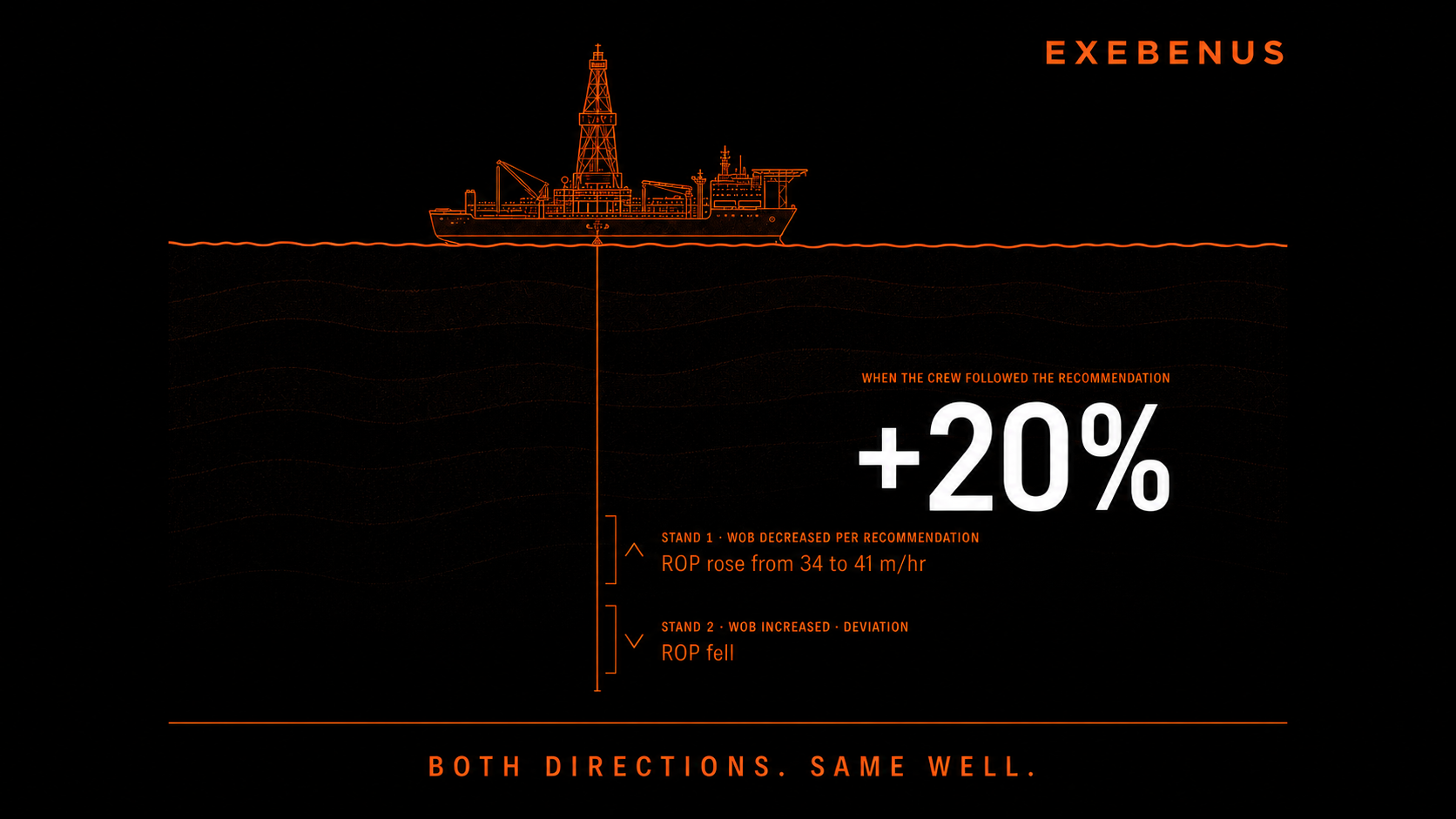
Spotter flagged "decrease WOB, hold on the next stand." The rig decreased WOB. ROP rose from 34 m/hr to 41 m/hr. Then on the next stand, the rig increased WOB again. ROP fell.
That is the cleanest validation a parameter-recommendation model gets. Follow it, ROP rises. Deviate, ROP falls. Same well, same formation, same BHA. The recommendation predicts a curve, and the rig traces it in both directions.
Why the inverse case matters
A drilling-efficiency model earns its credibility when the inverse case is in the data alongside the wins, and when the operations team puts both on the page.
Any vendor can show the stands where the number went up. The set that includes the stand where deviation cost ROP is the one an operator can actually evaluate.
Same dataset, both cases.