Stuck Pipe Agent
The Stuck Pipe Agent reveals developing patterns in friction and flow anomalies — so your team can act while there's still time.
Stuck Pipe Agent
Three patterns that lead to stuck pipe — detected in real-time:
Pattern
What's Developing
What You Can Do
Pattern
Static Friction
What's Developing
Static drag anomalies signifying differential sticking, sticking clays or other causes
What You Can Do
Keep pipe in motion and condition mud if possible
Pattern
Dynamic Friction
What's Developing
Dynamic drag anomalies signifying key seating, cuttings, unstable formations, string-bit weight transfer issues
What You Can Do
Condition well at depth of warnings
Pattern
Flow Anomalies
What's Developing
Anomalies in flow patterns signifying cuttings accumulation, swelling formations
What You Can Do
Circulate bottoms up while reciprocating
How It Works.
The Stuck Pipe Agent continuously analyzes real-time surface data to surface patterns buried in the noise — before they become obvious.
It monitors three friction signatures:

Static friction — detects drag and torque anomalies when the pipe starts moving after connections, commonly associated with differential sticking, hole collapse or sticky clays
Dynamic friction — identifies drag and torque anomalies during pipe movement, typically caused by key seating, cuttings accumulation, or unstable formations
Fluid friction — detects anomalies in flow and ECD patterns, often resulting from cuttings buildup or swelling formations
Each model runs continuously — predictive, objective, and consistent across every well. When a pattern develops, the agent surfaces what's hidden in the data — with enough time for your team to evaluate and act.
No configuration required. No historical data needed. Works across basins without retraining. Surface data only.
Your Advantage
Metric
Value
Warning time
Pre-warning accuracy
False alarm rate
Monitoring
Hours before incident — not minutes
>96%
<1 per 24 hours of operation
24/7 — patterns surfaced even when attention is elsewhere
Plus
Root cause identified — not just "something's wrong," but which friction type and why
Actionable recommendations — specific parameters to adjust
Explainable insights — every alert traceable to the underlying data
Works across your fleet — whether you're monitoring one well or ten, Spotter surfaces what needs attention
Continuous monitoring means smoother drilling overall — not just incident prevention. Teams using the Stuck Pipe Agent report fewer parameter adjustments, less reactive drilling, and more consistent performance across wells.
The result: best practice becomes the norm — fewer reactive decisions, more consistent wells.
How It Works With Other Agents
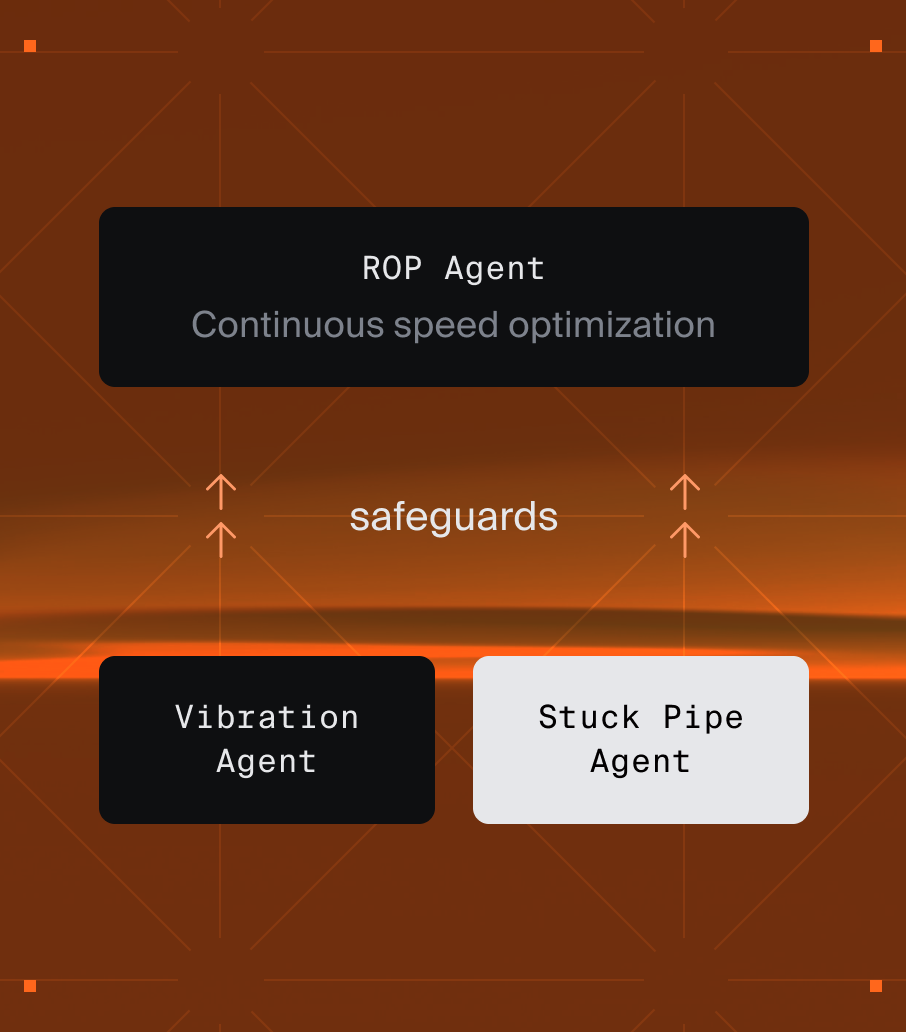
The ROP Agent optimizes drilling speed. The Vibration and Stuck Pipe Agents safeguard it — so faster never means riskier.
The Stuck Pipe Agent and ROP Agent communicate in real-time.
When hole cleaning issues develop, the ROP Agent factors this into its recommendations — so optimizing speed doesn't create risk elsewhere. A fix for one problem never creates another.
Case Study
NOC, Gulf of Mexico.
Context
Two agents converged on the same risk pattern; crew wiper-tripped before conditions escalated
Outcome
Salt transition zone flagged two hours early, stuck pipe avoided
